Showing posts with label Gibraltar. Show all posts

Friday, June 3, 2011

THE OTHER SIDE OF THE ROCK

I have been in and around Gibraltar for 20 years so when the Gibraltar Tourist Board recently asked me would I like to go on a tour to see some sides of the Rock perhaps I wasn’t aware of, what was my reaction?


For the answer to that question you have to go 1,000 miles north to my native London. As a child I walked every part of the city, West End, Westminster – you name it, I went there. Yet if you speak to the average Londoner whilst they rattle off the names of all the historic sites and attractions, they will then look guilty and say: “actually I have never been to the Tower of London”. Hence my immediate response to the GTB’s kind offer was an enthusiastic yes!

There are numerous ways to arrive on the Rock but probably the three main groups who visit Gibraltar are: tourists from the Costa del Sol who come by coach on a day trip; residents or holidaymakers who come by car and those who fly in and stay at one of the Rock’s hotels.

If you ask the majority of them what did they see their answer will be the airport because you have to cross the runway to get in or out, Main Street plus Casemates Square, the Cathedrals, the Trafalgar Museum, many will have done the Rock tour and seen the various tunnels dating from the years of siege and World War II, been out in the bay to see the dolphins plus of course visited Gibraltar’s famous apes or rather macaques.

I have done all these things numerous times myself often in the company of visiting friends and family. I have also been round the back streets and harbours but I didn’t realise until Gail took me on the tour the numerous places I have missed or was simply not aware of.

Gail is a former Miss Gibraltar and also a very fine artist yet at heart she is a Gibraltarian with a great pride in her Rock; the fact she works for the tourist board is almost incidental. I have yet to meet a Gibraltarian who wasn’t an ambassador for the Rock. We drove around for nearly four hours so what I saw would fill a book rather than an article. Here I will list just some highlights.

Devil’s Tower Road is not the most glamorous place on the Rock. It is an industrial zone which is now being beautified which may mean that in years to come the cave behind the buildings will become more accessible. It was here in 1848 at Forbes’ Quay they discovered the ancient skull of a woman. Eight years later in Germany they discovered an identical skull from the same period. That is now universally known as Neanderthal man but the world should really be talking about Gibraltar woman.

A non-Gibraltarian would never think of Gibraltar as a beach destination. It is a giant rock with harbours and the odd patch of sand over by the Caleta Hotel. The reality is very different with a splendid Eastern Beach but many others hidden away. Actually they are simple to find – you ask the tourist office.

When you used to drive along the eastern side of the Rock you passed an engineering marvel. The catchments literally caught the rain and it ran down the huge corrugated sheets into reservoirs in the Rock. Now they have gone but what is left is even more extraordinary. Once when the Med was land locked it was a desert and the winds blew the sand against the Rock face. The result was a huge sand dune now many millions of years old but which remains intact and newly planted with native species. Incidentally the Rock of Gibraltar is Jurassic limestone dating back some 200 million years but what you see is inverted because in the seismic activity it was turned upside down before the Atlantic roared in and created the Mediterranean.

Everybody knows that Gibraltar is British having been ceded by Spain in perpetuity by the Treaty of Utrecht in 1713. Prior to it being under Spanish rule it became part of the Muslim empire in the seventh century – its name Gibraltar coming from the Arabic Jebel Tarik – Tarik’s Rock. It was named after the Berber chief Tarik Ibn Zeyad who took if for the Moors. So logically there is British Colonial, Spanish and Moorish architecture to be seen. However apart from the Greeks, Visigoths, Phoenicians and Romans all passing through the modern day people of Gibraltar also come from Genoa, Malta, Portugal and numerous other places and that influence can be seen in the houses and buildings of the Rock, especially those in the myriad of side streets.

Queensway Quay has long been popular with tourists but there are now many other marinas in Gibraltar. Perhaps the pride of place goes to Ocean View with its stunning development of top of the market apartments which hide the harbour. Apart from a 24-hour casino it is packed with bars and restaurants on pontoons – some with live music. It is the first port of call for Gibraltarians on a Friday night. The weekend starts here.

I think for me the highlight of the visit was the new King’s Bastion Leisure Centre. The King’s Bastion is a key part of Gibraltar’s heritage because it was from here that the Spanish siege was finally defeated. So expect an old fort inside the thick stone walls of which are displays of its historic past. However in the centre is a totally new glass building with a bowling alley, cinemas, ice rink, gym, kids and adults disco, a restaurant, snack bar, pool tables, internet centre plus much more. Security is a top priority so Gibraltar’s youngsters (and young at heart) can relax and enjoy themselves in complete safety.

I have merely scratched the surface of the Rock here because there is much more to see and do. However whether you spend a day on the Rock or visit for longer please do contact the Gibraltar Tourist Board. Their main office is in Casemates Square but there are others at the border, cruise terminal, coach park and so on. If you don’t you’ll still see the Rock but you’ll miss out on so much of the Gibraltar experience. Like the ghost of the nun at the Governor’s official residence – The Convent. Ask the tourist office, they’ll tell you all about her tragic story.

Gibraltar Tourist Board

(The pictures of the Gibraltar aerial view and the King’s Bastion are the copyright of Gail Francis Tiron. To see more of her work visit her website at www.gailfrancistiron.com)


Monday, March 14, 2011

MY BOAT IS BIGGER THAN YOUR BOAT

Spain’s minister of the interior, Alfredo Pérez Rubalcaba, recently officially received the new Guardia Civil patrol boat, the Río Segura, in the port of the Bay of Cádiz. It is the largest vessel to be acquired by the maritime service of the Guardia Civil. It will largely be assigned to service on the high seas in the fight against drug trafficking and illegal immigration.


This is the continuation of a process started in 2007 when the first two ocean going vessels were acquired by the Guardia Civil – the Río Tajo and the Río Miño. These are now also backed up by reconnaissance aircraft.

The Río Segura is 73 metres long, weighs 2,100 tonnes and can be on patrol for 60 days. It has a crew of 39 people but in the case of a rescue on the high seas can take on board another 80. It also has a tele-medicine system on board.

The ministry of the interior also announced a new Guardia Civil unit with its HQ in Cádiz’s port that will serve the Strait area and will use the Río Miño with 32 crew starting operations in April.

Now the first thing that has to be said about the Río Tajo and Río Miño and the new super patrol vessel the Río Segura with relation to Gibraltar is that the British Government is fully aware of their existence. The first two have taken part in a number of international drug operations working with SOCA – the UK’s organized crime agency. Indeed it is likely that the Royal Gibraltar Police either through SOCA or links with the Spanish law agencies have also been involved. Hence in the future all three patrol boats will work with the British police and security agencies in the international war against drugs and people trafficking.

So what is the Gibraltar perspective on this? First it is the RGP and the local port and customs agencies to decide what size of vessels they need to perform their duties in the waters surrounding the Rock. In the end it is a political decision whether they receive these resources or not but it should be a professional request for the equipment to meet the task. So what do they need, have they asked for it, have they received it?

Secondly the waters around Gibraltar are British so it is for London and not No 6 to decide whether the patrol boats used by the Royal Navy are up to the job or whether more fire power is required.

Certainly in Rubalcaba’s statements no mention was made of Gibraltar or its waters in relation to the Segura, Tajo or Miño. That is not to say one or more will not appear around Gibraltar either in the course of its duties or as a perceived incursion in to Britain’s territorial waters.

When those incursions occur then the Gibraltar Government of the day should speak out openly to denounce the violation of its waters – and let both London and Madrid know of its anger. However it is for Britain to take action – yet it has to be realised that the days of sending a gun boat, even if Britain still had one, have long since gone.

The British police agencies work closely with the ministry of the interior as well as the Guardia Civil and Policía Nacional. Hence the British Government should make plain that whilst the Segura, Tajo and Miño work on the high seas with SOCA to combat international crime it is not acceptable for the same vessels, or their smaller versions, to violate Britain’s international recognized territorial waters around Gibraltar. Cooperation works two ways.

Wednesday, February 23, 2011

ESCAPE TO GIBRALTAR & JIMENA MEMORIES


February 23 1981 marked a significant day in Spanish history. It was the day the fledgling democracy of Spain was almost brought to its knees by the attempted coup in which the Guardia Civil Lieutenant Coronel Antonio Tejero marched in to the Spanish parliament, confronted the MPs and fired shots in the chamber.

It seems like a historical event now but was just 30 years ago. What took place is all the more significant now given the events taking place in the Arab world as nation after nation attempts to break the shackles of dictatorship (albeit in some cases by a sovereign and his extended family) and embrace democracy.

In the event apart from the events in Madrid with support from Valencia the coup fell flat on its face with a significant role in its downfall being played by King Juan Carlos I. However it is clear from statements made on the anniversary that those on the left and the unions feared for their very lives.

One of those, Antonio Herrera, now in charge of the health section of the CC.OO union told how shortly after Tejero had stormed Congress and the coup was underway he left one of Málaga’s hospitals. He saw youths wearing t-shirts emblazoned with the Spanish flag. He went with union colleagues to the Nadiuska restaurant in Gibralfaro and then to the Cádiz road. It was there that the Communist MP, Paco Vázquez, offered to take him to Gibraltar. He declined and says that later friends in the police told him at the time they knew exactly where to find each and every one of them. However what seems certain is that if the coup had succeeded many on the left and in the unions would have sought refuge in Gibraltar.

Final word goes to José Carracao who is now a senator in Spain’s upper house with special responsibility for Gibraltar and cross border relations. So what are his memories of February 23 1981? He told me: “I was the mayor of Jimena de la Frontera. That afternoon I had called a routine council meeting. A friend informed me of the news. I listened to the radio. That confirmed it. I was worried for the MPs detained. You cannot hide something of such major concern and who knew how things would develop in Jimena. Once the King spoke on TV at 01.30 on February 24 I knew the coup would not succeed. It would have been highly regrettable if our country, Latin and bloodied, had returned to the old ways. The behaviour of the people in the defence of democracy was exemplary.”

Footnote: Antonio Tejero is still alive. He was sentenced to 30 years in jail but in 1993 was given open regime status. He lives in Madrid but has a holiday apartment on the Costa del Sol in Torre Del Mar. He has refused to speak of the events of February 23 1981.


Saturday, February 19, 2011

GIBRALTAR CAN BENEFIT FROM TURMOIL IN BAHRAIN

First it was Tunisia, then Egypt and now Bahrain. The difference with Bahrain is that whilst Egypt was on the experts’ list of Arab nations who could topple the Gulf State was not. Not only that whilst other States in the region obtain their wealth from oil, Bahrain doesn’t, it is largely a business centre.


On Thursday Britain’s Foreign Secretary, William Hague, told the House of Commons, he is advising British nationals to avoid all but essential travel around Bahrain and to stay away from the protests.

Hague condemned the clashes between anti-government protesters and riot police in Pearl Square and called on the authorities there to “exercise restraint.” At least four people have died during the demonstrations.

The airport Manama is still open as normal but the Foreign Secretary is promising to keep the situation under review.

William Hague said he’d spoken to the Foreign Minister of Bahrain and conveyed his concern about the level of violence, stressing the need for peaceful action to address the concerns of protesters.

The demonstrators want to force the ruling Sunni monarchy to give up its control of central government, with the country’s majority Shia claiming they face discrimination because they are effectively blocked from key roles in public service and the military.

Meanwhile neighbouring Oman has raised the minimum wage for nationals working in the private sector from $364 to $520, in the response to protests sparked by the unemployment and poverty in Arab countries.

The state news agency ONA reported the cabinet had “decided to raise the minimum wages for national workers in the private sector to 200 riyals per month” on the orders of Sultan Qaboos.

This begs the question how can you run an international financial and business centre when foreign nationals are advised to avoid your country, when there are tanks and blood on the streets, and when everyone fears the contagion could spread to every nation in the region. The answer in short is you can’t.

So could this unrest benefit Gibraltar? Despite the political nonsense between Britain – Spain and Gibraltar, which after all has been going on for 300 years – the Rock as its name suggests is a pillar of stability in a troubled world. Not only that but it has a world respected financial, investment and legal centre.

I asked my man in the pinstripe suit who walks the Rock’s fiscal corridors of power how he saw the situation. He told me: “I think that the unrest in Bahrain could benefit Gibraltar quite substantially.” But, yes there was a ‘but’ to his views, for he continued: “only if Gibraltar makes a real effort to engage energetically in identifying and pursuing this business at both a high level and also on the ground.”

So yes Gibraltar can benefit from this uncertain world and boost its standing as a world financial centre in to the bargain – but – only if it is up to the challenge.

It is Gibraltar’s moment of truth.

Monday, December 20, 2010

PICARDO’S CHALLENGE - And will there be a challenge to Picardo?

There are no certainties in politics. When I started writing my Gibraltar Viewpoint column back in 1993 it was in the last years of the Bossano Government. The chief minister Peter Caruana first won power back in 1996 so when the election is held next year many of the first time voters will only have been aware of his GSD administrations.


If you’d asked me back then who were likely future chief ministers I would have said Keith Azopardi and Peter Montegriffo – indeed their days may yet come. Despite his recent horrific injuries at the hands of a knifeman Daniel Feetham may still aspire to and achieve the top job in Gibraltar politics. In contrast Fabian Picardo’s arrival as a potential leader of the GSLP and hence after the next election the Rock’s Chief Minister is by contrast a recent affair.

Joe Bossano has stated both to the electorate and his party that he will not lead the GSLP in to the next election. If that is the case then a new man or woman must be at the helm by the time the GSLP goes to the polls. The seeming front runner is Fabian Picardo – yet politics has a habit of seeing the front runner fall at the last fence.

If I asked you early this year who would be leading the British Labour Party after the defeat of Gordon Brown I wonder how many would have come up with the name Ed Miliband. Certainly not his brother David - the former foreign secretary and heir apparent.

Currently the opinion polls show wide spread support for Fabian Picardo as the next GSLP leader and a coalition co-led by Dr Joseph Garcia would offer a strong challenge to the GSD and an exciting alternative for the voters. It worries the GSD as can be clearly seen by their attempts to rubbish it this early in the game.

So why did Fabian Picardo throw his hat in to the ring? He explained: “I decided to say publicly that I felt I was ready to stand when Joe Bossano confirmed last year to the AGM that he would not be seeking the post of leader this year when the post is due for re-election. I have had only encouragement since then from members of the party and its executive and a vicious response from my political opponents who have not passed up any rumour in an attempt to denigrate my candidature.”

So is he looking to step in to the job or fight off an opponent or opponents in an election?

“I don’t believe in coronations and would very much welcome a contest for the leadership of the GSLP.”

The problem for observers like me is it is difficult to see where the challenge would come from. One name that has been mentioned in the past is Gilbert Lucudi although of late he has slipped out of the public eye and down the opinion poll ratings. However his hat could still be in the ring. Lucudi told me: “Under the GSLP constitution, the leader has to stand down every two years. We did not have the election of a leader at our AGM at the beginning of this year. This means that there will be a leadership election in the New Year. Our constitution requires that this be the case. I have not yet decided whether I will be putting my name forward for this leadership election.”

Joe Bossano has been a colossus on the Gibraltar political stage and of course was the founding father of the GSLP so I asked Picardo how he thought this transition should be handled. He told me: “I have no doubt that whoever becomes the next leader of the GSLP will be respectful of the contribution that Joe Bossano has made and I know will continue to make to the GSLP and to Gibraltar generally.

“Not even Mr Bossano’s detractors can deny the massive contribution he has made already and will make in a new GSLP/Liberal administration as we put our common energy and fresh ideas at the disposal of the people of Gibraltar. The "transition" will be no more than a generational evolution at the top of the party that will consolidate its policies for another generation.”

(The above appeared in the Monday December 20 edition of Panorama).

Wednesday, December 1, 2010

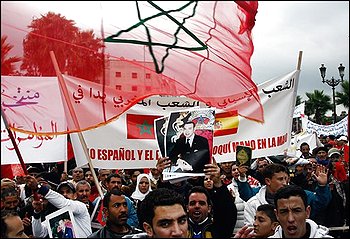
MOROCCO MARCHES AGAINST SPANISH CENTRE-RIGHT

Hundreds of thousands of Moroccans marched on Sunday in Casablanca to protest against criticism by Spain’s Partido Popular of alleged human rights abuses in the disputed Western Sahara. Waving Moroccan flags and banners, the protesters led by Prime Minister Abbas el Fassi chanted: “Popular Party, enemy of Morocco.”


I say hundreds of thousands, one report I read said three million. If there is a demonstration in Spain the organisers may say 5,000 took part, the National Police 3,000 and the local police 1,500.The truth lies between the highest and lowest figure. There certainly was a major demonstration in Casablanca – as to how many were there – well your guess is as good as mine.

I have reflected on this for a couple of days because the protest wasn’t against Spain or the Spanish government but the Partido Popular. The curious thing here is that the PP is not the Spanish party of government but is the opposition. I can’t think off hand of any other mass protest against a non-ruling party. However opinion polls point to the centre-right party triumphing in the March 2012 general election – not only in Madrid but perhaps also in the regional government in Andalucía, the nearest part of Spain to Morocco.

In statements over recent months the PP has made it clear that if it wins the 2012 general election in will be much tougher with its neighbour across the Strait of Gibraltar. It has accused the PSOE government of weakness towards Rabat, is angry over the EU accord with Morocco that will hit Andalucía agriculture and fisheries and has been outspoken in its support of the security forces in Ceuta and Melilla – the two enclaves that Morocco views as occupied territories.

Indeed in August the former Spanish PP premier, José María Aznar, broke off from his holiday in Marbella to visit the Melilla border where tensions were running high between the enclave and Moroccans. Morocco had accused the National Police and Guardia Civil of acting in a racist manner towards its citizens and a food import blockade had been imposed. Needless to say the visit of the strutting Aznar did nothing to calm these troubled waters. That was left to the Spanish monarch who has close ties with his Moroccan counterpart.

Now we have to add to that mix the Western Sahara which is normally the sole preserve of the left. The PP took part in a rally in Madrid last month alongside socialist, far-left and trade union groups to denounce Morocco for allegedly abusing human rights in Western Sahara. PP activists were also present in Valencia last week to show their support for Saharan refugees who had first locked themselves in the PSOE HQ as they are furious over the socialist government’s inaction on the issue. When evicted they staged an on-going protest in the street outside.

So on reflection it is no surprise that Fassi’s Istiqlal party and 15 other political groups issued a joint statement attacking the PP for its “unbridled activism against Morocco.” They argued the party had swayed last week’s vote of European lawmakers in favour of a United Nations-backed probe into violence in the former Spanish colony.

Moroccan security forces and pro-independence protesters clashed on November 8 in the disputed territory, which was annexed by Morocco in 1975 after Spain withdrew from its former colony. Several members of the security forces and civilians are reported to have died. The violence, amongst the worst in years, prompted the Polisario Front which wants independence for the territory to call for an independent UN investigation.

With the centre-right is in the ascendancy in Spain you can expect tensions with Morocco and the British colony of Gibraltar to increase if the Partido Popular comes to power. It is also a depressing prospect for socialists, the far-left and the unions in Spain because whilst the country has suffered in the economic crisis under the socialist government the medicine to come will be far bitterer under Mariano Rajoy’s PP than it ever was under José Luis Rodríguez Zapatero's PSOE.

Wednesday, October 20, 2010

BOSSANO CAN’T BE THE ELECTION ISSUE

In Panorama on Monday Joe Garcia gave a fine forensic analysis as to why the chief minister might be opting for calling an election either before Christmas or shortly afterwards. Caruana is a wily fox and he would indeed be mad if the options laid out in that article were not being considered by him and his fellow GSD members.

Over the last year I have discussed the pending GSLP leadership change with members of the party. I have been assured that it will happen in the early part of next year so the new leader can be installed before a general election at the end of the year. But what if Caruana goes early I keep asking? To date I have yet to receive a satisfactory reply.

Joe Bossano signalled at the last election he would not contest another as leader and I believe him. However if the chief minister announced an election now the GSLP would be in turmoil. It would either have to have an internal election before turning its attention to the general election, a new leader could be shoe horned in – hardly an ideal solution - or Joe would carry on at the helm to after the election and then stand down, sometime.

Whenever the election is called the main issue should be the stewardship of Gibraltar’s affairs by the GSD since 1996. The public if the opinion polls can be believed had had enough of Caruana and the GSD and want a new government. The GSLP – Liberal alliance led by Fabian Picardo and Dr Joseph Garcia would offer the Rock a young yet experienced partnership. Equally another parliamentarian such as Gilbert Licudi could win the GSLP crown but the offering to the voters would be the same. If the GSLP went outside its MPs then we would have to see who was chosen to lead.

If it is Picardo or Licudi partnering Garcia then Caruana and the GSD would have their work cut out. The electorate has presumed that Bossano would be yesterday’s man by polling day so when asked who they would vote for have factored in his departure yet they still opted for the GSLP – Liberal coalition.

Bossano becomes an election issue if the chief minister moves quickly and leave the GSLP in turmoil with him still at the helm. Then Bossano and not the GSD’s record will be under the spotlight and that could prove fatal for the opposition coalition. I can see no reason why the GSLP cannot elect a new leader now - but if need be Bossano could lead the parliamentary team until the new man or woman has his or her feet under the table.

The GSD’s record in government has to be the issue and the attempts by the chief minister to wrap himself in the flag should fail miserably. First the GSLP and Liberals have been more outspoken than he in defending Gibraltar’s independence from Spain. In addition Caruana’s whole period in office has been dedicated to seeking accommodation with Spain through the Córdoba process and Trilaterals – that initiative now lies in ruins so trying to out Bossano Bossano won’t work.

Turning the heat on the Bossano issue would also deflect from the major problems within the GSD. Should Caruana run again or not? Will Montegriffo return? How many of the present government team will stand? Then there is the Feetham factor but that would take a whole article on its own.

(The above article appeared on October 20, 2010 in Panorama).

Friday, October 8, 2010

THEY SEEK HIM HERE...And no I’m not Karina Pau’s father

Great excitement in Jimena de la Frontera on Thursday morning. Just 30 minutes before this photograph of the popular Cuenca bar was taken the former mayor of Marbella, Julián Muñoz, was sitting outside sipping coffee. Within minutes a TV crew from Antena Tres had descended on Jimena trying to catch a sighting of Muñoz with his girlfriend Karina Pau who lives in the municipality and interview them.

Suddenly Muñoz disappeared, where to only he and Karina knows. Karina’s parents are Gibraltarian and recently Muñoz applied to the court to be allowed to visit them on the Rock on a monthly basis. Not surprisingly as Muñoz is currently in the dock in Málaga in the Malaya corruption trial – the largest of its kind in Spanish history - the judge refused to let him leave Spain.

Muñoz is alleged to have received 162,000 euros from the Malaya mastermind, Juan Antonio Roca, who was Marbella’s director of town planning. However the former mayor is also standing trial on a case linked to Malaya. It involves the famous singer Isabel Pantoja, who was his one time lover plus his former wife Mayte Zaldívar.

The case revolves around the time Muñoz was mayor of Marbella and the anti-corruption prosecutor accuses him of having siphoned off over 3.5 million euros of municipal funds for his own use. First he used his then wife, Mayte Zaldívar, to help launder this cash and once she was dumped the task fell to his then lover, Isabel Pantoja. It is alleged that Pantoja utilised the money to acquire an apartment in the Guadalpín Hotel and her house in Marbella, Mi Gitana.

If found guilty Isabel Pantoja faces three and a half years in jail plus a fine of 3.68 million euros. Julián Muñoz could be sent away for seven and a half years and have to hand over 7.6 million euros. His ex-wife Mayte Zaldívar would be handed a three and a half year prison term and a fine of 2.6 million euros. They each have to pay this money in to court ahead of the trial.

Given the large number of court convictions that are staking up against him it is no surprise that Muñoz is taking time out to enjoy a coffee in convivial surrounds whilst he can. There was one surprise yesterday. As I took a photograph of the Antena Tres cameraman I realised he was filming me. I later heard from my fellow journalist in Jimena, Alberto Bullrich, that they had rushed up to him demanding to know – “was I Karina Pau’s father?” Well you know that I am not, but hush, and let me enjoy my 5 minutes of Spanish TV notoriety.

Friday, September 17, 2010

A LINENSE VIEW

Yesterday in Panorama I gave my prospective of the damage inflicted on cross border relations by the malicious scheme by the mayor of La Línea, Alejandro Sánchez, to impose a toll on vehicles leaving Gibraltar and entering his municipality.

It was a viewpoint garnered from Gibraltarians but I believe it is also important to listen to the views of somebody living across the border in La Línea. Hence today I bring you the thoughts of Juan José Uceda Gil who although Spanish and living in La Línea has worked in Gibraltar for many years. He is also the spokesperson for many community groups in the border town including the Spanish workers (ASCTEG) on the Rock. Here he expresses his own personal view.

I asked him what damage did he think had been done to cross border relations by the toll fiasco? He replied:

“I have to say David that the majority of people know it was a political move, of the same kind that the political leader of the PP in Algeciras, Sr Landaluce is always attacking Gibraltar in the media on the themes of the patrols, the jurisdiction of the waters, pollution from the bunkering tankers, the nuclear submarines even though there are none, the airport because he wants it to be Spanish. Always this is very unjust it is the same with the mayor of La Línea who has re-opened wounds that were almost closed from when Franco sealed the border.

“Of course on both sides of the border there are extreme patriots who say these things in bad temper or “mala leche” yearning for times past and to harm relations.

“I do not agree personally with the views and the encounters of the CC.OO and UGT unions with Caruana and the Gib union, they have held a political meeting which has more to do with the need for support for the general strike on September 29 than any long term commitment.

“Also they have forgotten the other side – the Spanish workers in Gibraltar who are suffering psychologically because of the origins of the toll row.

“It has prejudiced the commercial relations that the same mayor initiated some months ago with industry and commerce in Gibraltar and with Mr Caruana when Sr Sánchez said to the unemployed of La Línea that thanks to his meetings in Gibraltar they are now negotiating to generate employment on various projects for the “third age” and others which because of professional secrecy he could not reveal.

“In the end the people of good faith in La Línea and Gibraltar above all, must forget what has happened, but Gibraltar has the pain of the closure of the border and it will take many years until all this is cured. You cannot simply erase what our mayor has done.

“The fact is that the majority people who live in La Línea are against what he wants to do.

“Alejandro took a week before we met to discuss the toll proposal. The meeting produced nothing productive because he had a blind spot as far as the toll is concerned and he wouldn’t withdraw the idea and apologise to the people of Gibraltar. I told him his proposal would create conflict to the point where the government’s delegate would have to intervene and he hoped the national media would depict him as the ‘linease’ hero.

“The PP high command in Madrid with members who are anti British and for the Spanish flag in Gibraltar insist to Alejandro that he continues with the toll because this opens the way for these people who are followers of the dictator and now there is proof that some people in the military have sanctioned it and the press says that the military does not want an accord based on the government’s policy towards Gibraltar.

“We are now preparing leaflets, posters and petitions which we shall be using from 7.30 this morning (Friday) in Gibraltar to advise that on Tuesday September 21 we have a demonstration at the border, without blocking it, by the statue of the Spanish worker from16.00 to 19.00 and if there are enough supporters we will go from their to the town hall.

“On Friday afternoon ASCTEG has its second meeting to form a group or action group against the toll and we have invited all the political parties (except for the PP obviously), community groups and the unemployed to join us.

“Mi opinión y lo que vida día a día.”

(The above article was published in Panorama on Friday September 17)

Thursday, September 16, 2010

THE DAMAGE IS DONE

On Monday Panorama carried my interview with Senator José Carracao who is responsible for cross border relations for the governing PSOE party. He urged Gibraltarians not to panic or be unduly concerned because he is adamant the toll (which will be levied on all vehicles leaving the Rock and entering Spain by La Línea town hall) will not be imposed. He urged the “strange behaviour” of La Línea’s mayor Alejandro Sánchez should not damage cross-border friendships. Hopefully not, but major damage has already been done.

This whole sorry episode has already impacted on cross border relations plus those between Gibraltar and Spain. I suspect it hasn’t between London and Madrid because the Foreign Office will take the view that Spain has sorted the problem and it’s behind the scenes diplomacy has worked.

Here on the ground though there is a different tale to tell.

The mayor of La Línea has set himself against the Spanish workers who cross the border each day and we have seen an alliance formed to fight the toll between the UGT – CC.OO and Unite which has further infuriated Sánchez.

There have been campaigns for Gibraltarians to boycott businesses in La Línea.

There has been traffic chaos on both sides of the border caused by Sánchez playing around with the road system and installing signs well before any start date for the toll.

My suspicion is whilst that damage is real enough it is in the hearts and minds of Gibraltarians where we will find the raw truth.

Ever since the Córdoba Accords were signed the GSD government has instilled a feel good factor on Gibraltar’s relations with Spain. It has trumpeted the meetings, the agreements, the co-operation and whilst many Gibraltarians have been frustrated by the continuing queues at the border pre Sánchez – and angered by the Guardia Civil incursions the message has been things can only get better.

Now Gibraltarians have seen the neighbouring mayor use them in his battle with Madrid to bail out his bankrupt town hall – ruined by the mismanagement and corruption of the GIL and PP era. They have seen the ‘bash Gibraltar card’ used shamelessly by Sánchez and the Partido Popular at national and an Andalucía level. They have seen the PP’s candidate for the Andalucía presidency, Javier Arenas, blasting the PSOE government for not getting tough with Gibraltar over the Guardia Civil, the land reclamation and Spain’s jurisdiction over the Rock’s waters. Here’s a leopard who has not changed his spots.

Lyana Armstrong-Emery told me: “After the events that led to the closure of the border and its re-opening twenty eight years ago to pedestrians it has taken these many years to build up the trust and good will between the two sides of the borders. It has taken a lot of hard work and co-operation from politicians, unions, NGO’s, organisations and ordinary folk to achieve this. Mr Sanchez has in a few weeks managed to damage cordial relations between the two towns and has revived distrust and memories of a very troubled past which will be difficult to reverse.”

Last Friday Gibraltar celebrated its National Day and despite the two shows in town Llanitos were united as a people because they again faced Spanish aggression. The old raw wounds were opened up and people saw past Córdoba to the reality – Spain wanted at least joint sovereignty and would not hold back from threatening and abusing the Rock in its own sordid internal political squabbles.

In his National Day message the GSLP leader, Joe Bossano, stated: “we will never, ever permit the Spanish flag over our homeland.” I suspect if you cut him open you would find those words engraved on his heart. Yet under Córdoba it could be argued we have moved on from that rhetoric of yesteryear. I suspect that if it hadn’t been for the harassment of the past year plus the toll fiasco Joe Bossano would have delivered a more forward looking, upbeat message. Yet he spoke from his heart and in so doing struck a chord with the majority of Gibraltarians.

Cross border relations lie battered and bruised whilst Córdoba is at death’s door.

(The above article appeared in Panorama on Thursday September 16).

Friday, September 3, 2010

FAR FROM QUIET ON THE WESTERN FRONT

The senator José Carracao, perhaps the most understanding of the mainstream Spanish politicians with regard to Gibraltar, recently told Panorama: “Gibraltar cannot be a British colony indefinitely.” He is of course right but not in the manner he envisages.

Now there are those who would argue that with the new Constitution Gibraltar has entered a post-colonial state. Equally there are others on the Rock who would contest that view. I am a hack and not a constitutional expert so will let that debate pass other than to observe there is no consensus on the issue.

I am a Briton of a certain generation so still hold emotional links towards Gibraltar yet I accept that the younger age groups in the UK do not. Yet I have no strong views on what the future status of the Rock should be. I have no strong view because I am not a Gibraltarian – my only firm belief is that whatever option is eventually selected it should be the free choice of Gibraltarians alone.

The status quo is that Gibraltar is under the British Crown possibly still colonial, may be not. Compare that with Ceuta or Melilla that neither Carracao nor any other Spanish politician would consider to be a colony. Although they lie across the sea in another continent they are deemed to be an integral part of Spain. This of course does open up the debate on whether Gibraltar should be integrated in to Britain but that is for another day.

In a recent letter to Panorama on the congestion charge Michael J Sanchez wrote: “Inaction is interpreted by Latin countries as ineptitude and weakness which the FCO in London has never come to grips with.” He sadly is right. Since the days the British Empire was dismantled the Foreign Office has been in a guilt ridden state over its former or remaining possessions.

Compare its agonised reaction to the on-going Spanish criticism over British involvement in Gibraltar with Spain’s stout defence of Ceuta and Melilla and outright rejection of Morocco’s claim to these territories. The Spanish monarch and his family are regularly sent across the Strait to demonstrate Madrid’s commitment to its enclaves. The premier and leading politicians walk its sands. Gibraltar’s Queen would never be allowed by London to visit the Rock and no British Prime Minister has been here since Churchill during World War II. Make no mistake if it wasn’t for the 1969 preamble the Foreign Office would have happily handed Gibraltar over to Spain lock, stock and ceremonial keys.

Now whilst Spain is contemptuous of Morocco’s claims over Ceuta and Melilla that does not tell the whole story. Back in 1975, in Franco’s dying days, Madrid handed over the Western Sahara to Morocco and Mauritania with an indecent haste that the Foreign Office would have been proud of. Mauritania later withdrew leaving Morocco to fill the vacuum and annex the territory.

This has led to an on-going fight by the people of the Western Sahara for independence backed by the Polisario Front that has drawn support from Morocco’s neighbour Algeria. Although the Spanish Government long ago washed its hands of its former colony many Spaniards have not.

At a basic level many communities in Spain take in the children from the refugee camps of the Western Saharans over the summer months. At a more acute level are activists from such organisations as SaharAcciones.

They are in the news because 14 Spanish pro-independence activists were arrested in the disputed Western Sahara on Saturday night and beaten up. The Moroccan police arrested them in El Aaiún, the chief town of Western Sahara. Moroccan government spokesman Khalid Naciri has since said in a statement: “The Moroccan government cannot take responsibility for what happened in El Aaiún, but that must be assumed by these provocative tourists.”

Madrid at first demanded answers from Rabat but then concluded the activists had “taken part in an illegal, unauthorised demonstration, during which these altercations took place.” Spanish premier José Luis Zapatero stated: “It is an essential principle of foreign policy to maintain a good relationship with neighbouring countries like Morocco." In other words “no surrender” on Ceuta and Melilla but Rabat can rely on Madrid’s compliance over the Western Sahara.

Western Sahara peace activist Aminatu Haidar said Morocco had demonstrated it has no respect for Spaniards or their government. Gibraltarians might say much the same thing about Spain.

(The above article appeared in Panorama on September 3, 2010).

Friday, August 27, 2010

WHEN GIBRALTAR WAS THE COSTA’S AIRPORT

I recently visited Málaga airport with its gleaming new terminal. A major airport without doubt, the busiest in Andalucía and one of the most important in Europe. Yet I have to say if you are dropping anybody off or collecting them as I was it is a nightmare.

I compare that with the almost homely existing terminal at Gibraltar’s airport. It is my favourite airport for flying from because it is never crowded and everything is just a short walk away. I expect even with the new terminal Gibraltar will be a happier flying experience than its neighbour up the coast.

I am musing on the two airports as I have just read a report on the days when Gibraltar was the Costa del Sol’s airport. I suspect there were no rows then over the Rock’s airspace or air traffic controllers disputing jurisdiction. I gather though that the customs on the Spanish border were no more user friendly then than now.

In the 1950s Málaga had an airport although airfield would have been a better description. No gleaming terminals but rustic buildings. No tarmac runway just a grass strip. The runway was too short to accommodate the larger aircraft of the day and even those who did fly the route often had to be diverted because bad weather conditions would require the airport to close.

Down the coast at Gibraltar it was a different story. The much loved and lamented British European Airways flew this route from the Rock to London with some aircraft going via Madrid. Today, of course, BEA is no more having merged with BOAC to form British Airways.

Hence anybody in the province of Cádiz or Málaga who wanted to fly to the Spanish capital, go to London or use BEA’s Heathrow’s links for onward travel to Dublin, Copenhagen, Amsterdam and so on had to fly from Gibraltar.

BEA operated its workhorse the Viscount on this route. On arrival on the Rock passengers for Spain then had to negotiate the customs officials at La Línea. Once that challenge had been met it was on to the BEA Road Service – a famous transport link of the era.

The BEA buses drove up and down the then very basic road to Marbella where many of the tourists disembarked. The majority were British and others travelled on to stay at one of Spain’s first Costa-styled resorts – Torremolinos.

All this came to an end after 1959 when a tarmac runway was laid at Málaga airport and it was extended to 2,000 metres. State of the art navigation equipment for those days was also installed and so the Convair Metropolitans, DC-4s, Vickers, Bristols, De Havillands, Viscounts and Comets started to touch down. The Costa del Sol was born and the rest is history.

Yet without Gibraltar airport those first intrepid visitors to the coast would never have arrived by air at least. So the Rock’s airport has a firm place in the history of the development of Spanish tourism and the British holiday makers’ love affair with the Costa del Sol.

(Photo: Marbella – 1950s. This article first appeared in Panorama)

Tuesday, July 6, 2010

POLITICALLY GOBSMACKED

There have only been a few occasions in my life when I have been Gobsmacked and I have just experience another rare occurrence.

The Gibraltar Government has just announced that Clive Golt is its new media director replacing the late lamented Francis Cantos.

Certainly Mr Golt, a one-time stalwart of the GBC and more latterly the editor of the GSLP-leaning New People, has all the credentials for the job and more.

He resigned from his GBC post to stand as a GSLP candidate in the 1996 elections. Sadly for him the GSLP lost power, he wasn’t elected to the then House of Assembly, and has spent the years since out in the cold.

Perhaps cold is an understatement as the relationship between Mr Golt and the Chief Minister, Peter Caruana, his new employer, was at best frigid. Numerous rows and unpleasant accusations went to and fro between the two in public. I bite my tongue!

Now Caruana says he has never doubted Golt’s “personal integrity” – whoops there goes another political pig flying overhead.

Still Mr Golt is now a civil servant and should the GSD lose power next year as the opinion polls predict, he will still be in the job serving the new GSLP government.

Which is where he wanted to be in the first place.

A smart move therefore by Mr Golt but Mr Caruana has left me Gobsmacked!

Friday, July 2, 2010

A TALE OF TWO BUDGETS

On Thursday I sat in Gibraltar’s parliament as the chief minister, Peter Caruana, delivered his budget speech.

Later that afternoon I spoke on Talk Radio Europe with Peter Cochrane and said it was like sitting through a speech from another era.

Gibraltar has around five per cent growth (what’s growth Obama, Brown, Cameron and Zapatero cry?). There is a surplus. Low national debt and unemployment. Taxes for Gibraltarians and businesses are coming down.

It would be wrong to say that Gibraltar has escaped the effects of the world economic crisis but it has had nowhere near the chaotic impact as in the EU or USA.

Across the border from Gibraltar sits the Spanish town of La Línea. As a cruel reminder of what the crisis means for ordinary people I also wrote yesterday about the 10,000 signed on at the local unemployment office and the thousands of others, who are not registered, receive no hand outs and rely on the Red Cross (Cruz Roja) and the Catholic charity Carítas for the food on their tables.

Of course there are very many Gibraltarians who are not happy with the chief minister’s speech or his performance in government. If you go to Facebook, key in Fabian Picardo, you can read his comments from parliament as he and the GSLP – Liberal opposition - of which he a member - peppered the GSD government ministers with difficult questions and came up with some unhappy answers.

That is why I say this is a tale of two budgets – the same document that wows the outside world appals many Llanitos. So much so that the GSD trails the opposition in the opinion polls and Caruana may well be facing his last year in office after being in the post for an awesome four terms.

Monday, June 7, 2010

NOT A ROAR WAS HEARD

We made our way through lush sub-tropical trees and bushes to the clearing.

There was a large glittering pool of cooling water. “It’s the sea”, said Hassan. It certainly looked blue and clear but it couldn’t be the sea because we were half way up the limestone rock that towered green and splendid above us.

A loud raucous noise broke out to our right. Ahmed calmed us, apes he said – but we weren’t sure if they were roaming free or caged.

At that moment the governor of these parts strode past and made his way to under a giant awning.

A large pride of lions came in to view, all dressed to kill, they left us unharmed.

Ahmed waved us to a table by the glittering pool. We had come to eat and a plate of five Spanish tapas was placed before us. In the centre was a small shot glass of gazpacho with a crouton stick surrounded by a chicken thigh, a cheese tartlet and other delights.

Toby broke cover to ensure all was well before returning to his beloved lions.

A sorbet followed to cleanse the palate then a barbecue but not as we know it. No drunken sweaty men surrounding hot coals here. The plate was laid out in the style of the finest restaurants with a delicious mix of delicate vegetables surrounding a generous steak. Opposite me sat a mound of mushrooms as large and tender as meat with asparagus that melted in the mouth. All was washed down by a wine that whispered it was a well-heeled chardonnay, the tongue believed it but the price tag tempted you to order a second bottle.

As the night closed in on the rock above, the birds circled. A small boat made to the exact scale of the traditional local fishing vessels, bedecked in candles, set sail on the water and a plate of tapas desserts arrived in front of us that were to die for.

Hassan brought us coffee, a light for the table lamp and a generous smile.

Toby appeared through the bushes one last time to ensure we had enjoyed our evening and to see us safely on our way.

If you would like to share the Rock Hotel’s Al Fresco dining experience - every summer night - at its beautiful poolside restaurant click here for the link to Gibraltar’s oasis in a busy world.

(By the by the Governor of Gibraltar, Sir Adrian Johns, is president of the Gibraltar Lions who that same night were entertaining their Spanish counterparts but not a roar was heard).

Thursday, June 3, 2010

WILL THE GSD MAKE THE NEWS?

Some years ago I wrote that when the colossi of Gibraltar politics, Peter Caruana and Joe Bossano, decided to call it a day it would cause major seismic change.

Well Joe Bossano has announced he will not lead his GSLP in to the elections expected in 2011. He founded the party and will be a player but he will not be the Rock’s next chief minister if the GSLP – Liberal coalition triumphs as present opinion polls indicate it will.

I presumed this would be the news, now I am not so sure. Joe Boss has delivered a GSLP in good shape to the next generation of leaders and the alliance with the Liberals has never been stronger. So maybe the news will be elsewhere.

Peter Caruana led his centre-right GSD to power in 1996 and has been a victor at the polls on four consecutive occasions. So surely he’ll go for a fifth victory or will he?

Gibraltar’s legendary leader, Sir Joshua Hassan, was a four term chief minister so Caruana has matched his record. If Caurana went for a fifth – and won – he would cement his place in the Rock’s history. Yet if he lost he’d be remembered more for that defeat than his victories.

So why should he pass up another attempt? Two opinion polls in the Chronicle and Panorama have suggested he would be defeated. Polling day is still a long way off but if the people of the Rock have decided it is time for a change there is little Caruana can do to stem that tide. Also the Bossano bogeyman will no longer be there to poke a stick at – the GSLP – Liberals will be led by a new generation of politicians – as Cameron and Clegg have demonstrated it can be an irresistible combination.

If Caruana did lose I doubt he would hang about to lead the loyal opposition as Bossano has. He’d rush off in his wig and gown to earn some dosh at the Bar.

Which of course leaves his GSD in a quandary. It had been assumed that his deputy Joe Holliday would be the man to take over but there have been suggestions he won’t be a candidate at the next elections even if Caruana fights on. This would open up a power battle within the GSD that could split the party asunder.

The minister of justice, Daniel Feetham, has ambitions to the top job. However a political carpet bagger he may be but also at heart he is a socialist. His father was a minister in one of Bossano’s administrations, Danny was a member of New Labour in the UK, joined the GSLP but stamped his foot when Bossano wouldn’t stand down, rushed off to form the Labour Party and after getting a bloody nose at the polls scampered off to be Caruana’s bag carrier before being elected at the last election.

Feetham joining the GSD and its merger with his Labour Party has already caused a split with several key members including political heavyweights Keith Azopardi and Nick Cruz going off to form the PDP. It is difficult to see Feetham leading a party whose core membership oppose everything he stands for. However if he tries and fails it could see the leaders of the struggling PDP and perhaps former deputy chief minister Peter Montegriffo returning to the GSD as soon as Caruana is out of the door.

I suspect whilst all eyes are currently on the GSLP it is the GSD where the action will be. I shall keep looking in both directions.

Thursday, May 27, 2010

BLUE IS THE COLOUR

Recently a Gibraltar St John’s ambulance was stopped as it took an elderly patient to a private hospital in Benalmádena – around 100 kilometres from the Rock.

It was waved down by a Guardia Civil patrol because the ambulance was flashing blue emergency lights and not the amber ones permitted in Spain. The driver was fined – but as he didn’t have sufficient cash on him – the amount was reduced – I kid you not!

Before I proceed I should point out that Gibraltar ambulances frequently cross in to Spain and indeed vice versa – but this is the first time there has ever been such a distasteful and potentially tragic incident.

Now Gibraltar’s Shadow Health Minister, Neil Costa, has dug up some intriguing information on the issue. It turns out the European Union standardised back in June 2007 the emergency lights to be shown on an ambulance capable of transporting at least one person on a stretcher. The colour is blue.

The EU took this step to ensure all emergency vehicles – ambulances, police and the fire brigade – showed a uniform colour – blue – especially as such vehicles had on occasions to cross the border in to a fellow EU State.

There are only two EU countries that did not comply with these regulations – Spain and Greece. In Spain only the police agencies can use blue – other emergency vehicles have to use amber.

Neil Costa added: “The Guardia Civil must have immediately recognised the ambulance was from Gibraltar when it was stopped and fined it so that it is not clear what purpose was served by such an unnecessary action.”

Indeed if the encounter between the Guardia Civil and the ambulance wasn’t so shamefully it would be laughable - but then life and death is never a laughing matter!

Monday, March 29, 2010

QUIRKY ON THE ROCK

When I was at school large chunks of my atlas were still coloured red. The days of empire were over (no I’m not that old but old enough) but the colonies still existed. In the centre of the book were black and white photos. The Taj Mahal was always one along with the Table Mountain and the Rock of Gibraltar.


Well I lived under Table Mountain for a short time in the 1980s and since the 1990s the Rock of Gibraltar has been on the horizon or a near neighbour. The Taj Mahal has yet to be visited...but I have dined at a restaurant of the same name – in Shepherds Bush I think.


The most famous hotel in Gibraltar is the Rock – as the name suggests it is perched on the side of the limestone monolith with outstanding views across the bay to Algeciras and the Strait to Morocco. It was built in 1932 by the Marquis of Bute and over the intervening years became one of the Med’s most distinguished hotels - a home from home for the Britons sailing the high seas to and from old Blighty. Needless to say many famous people have stayed there – their photographs adorn the Barbary Bar wall.


Today’s world is very different but the Rock Hotel retains much of its old world charm. It has every convenience that the modern traveller could want down to Wi-Fi in its bedrooms. Yet there is a quirkiness about the hotel which I suspect can be laid largely at the door of its general manager Stephen Davenport. When I tell you he is an Arsenal supporter – those who known their soccer will nod wisely. There are ducks in your bath, lollipops in your room and macaques (apes to you and me) on your room key – yet the real quirkiness emanates from the proud hotel’s very walls.


I went to the hotel to sample the fondue – quirky indeed as I haven’t had one for over 35 years. Yet it wasn’t that splendid meal or the sumptuous breakfast that caught my imagination. It was the awe inspiring beauty of the setting. The hotel has a famous wisteria terrace and this magnificent vine was in full bloom. The views of the sun setting behind the Algeciras hills were magic – you could almost reach out and touch Morocco on your left. Then in the dark the lights shine before you from San Roque round to Algeciras and from across the Strait in Tangier - whilst the hustle and bustle of passing ships in one of the world’s busiest waterways ensures an ever changing backdrop to sip a coffee and whisky from your terrace before bed.


I have no knowledge of what lies in the future for the Rock Hotel. Just experience tells me that at sometime in the years to come some bright spark will seek to improve what in its quirky way is already perfect. Therefore sooner rather than later take the opportunity to stay at this oasis of calm – a throwback to a past age – and you can always send photographs of your experiences from your laptop as you sit below the magnificent wisteria sipping a sun downer. How quirky can you get!


Monday, March 15, 2010

UP THE POLL

When I was a child, which was many years ago, if somebody was thought to be a bit mad they were said to be up the pole.

I have just read in the Gibraltar Chronicle the latest opinion poll carried out amongst the Rock’s electorate and can’t help wondering if “up the poll” applies here.

It reports that the “pro-government newspaper” 7-Days says the ruling GSD will romp home with 32.73 per cent of the vote with the GSLP – Liberal coalition on 18.18 per cent.

Now I have been a Gibraltar watcher for 18 years and I can’t ever remember there being that wide a gap between the parties. Indeed in recent outings to the ballot box it has been a matter of several percentage points dividing the two.

Apparently 440 people were sampled which given the size of the Rock’s electorate is a good number. The same poll shows 37.27 per cent undecided which also has me scratching my head.

There will be one major change when Gibraltar goes to the polls either this year or next. It is expected that the veteran GSLP leader and former chief minister, Joe Bossano, will step down and that another younger blood will head the party. The most likely new leader is Fabian Picardo although Gilbert Lucudi might dispute that. Interestingly whilst this poll said 8.18 per cent favoured Joe Boss as chief minister, 6.36 preferred Fabian Picardo against the 31.98 per cent of the incumbent Peter Caruana. Thirty-five per cent didn’t know.

Now a cynic might say, so that’s me off the hook, that given that the poll was carried out by 7 Days it was merely a distorted campaigning piece for the GSD. May be so – but in recent elections the Gibraltar daily Panorama has been uncannily accurate in its polls – and it is in the opposition camp.

I have certainly not detected any such massive public opinion swing since the last elections or that the Gibraltar voters are so undecided on who to vote for. However I do acknowledge that if Joe Boss does step down from the leadership of the GSLP then it will mark as big a sea change in Gibraltar’s politics as Margaret Thatcher resigning the leadership of Britain’s Tories – and that could factor in the electorate’s indecision.

Monday, February 22, 2010

THE MARRACHE AFFAIR

Make no mistake the furore surrounding the arrest of two of the three brothers who headed up the Marrache & Co law firm in Gibraltar has sent shudders through the financial services and legal sectors. The Financial Services Commission was the first to act to withdraw the licences it had issued to Marrache’s allowing it to take clients’ investment funds.

However the financial arm of the law firm was probably the least well known and it is as a legal practice with offices in Spain, Portugal and the UK – as well as the Rock – that had made Marrache’s famous. Indeed up to two weeks ago they would have been rated at least by those outside the legal beagle world on the Rock as one of its top firms. Whether its fellow lawyers had any inclining of what was afoot we are yet to find out.

Last week Benjamin and Solomon Marrache, the two brothers facing multi-million pound fraud charges, were refused bail and remanded in prison by the Magistrates Court. Stipendiary Magistrate Charles Pitto said there was a high risk of the two men fleeing Gibraltar as the police probe into the affairs of Marrache & Co intensified. Attorney General Ricky Rhoda, QC, said the scale of the alleged fraud appeared to be larger than investigators first thought. If convicted it is said the brothers could spend up to 10 years in jail, presumably on the basis of the charges they now face. I would guess that if more wrong doing is discovered then their future lives behind bars may be extended.

Benjamin and Solomon appeared in court last week jointly charged with falsely accounting $5.6 million Canadian dollars and 2.1million euros belonging to Malory Holdings and Remus Enterprises. That is in addition to the charges of falsifying documents to conceal 1.8 million euros of missing money belonging to another client they already face. Prosecutors claim they falsified ledgers to show that they held the clients’ money when in fact it was missing.

Initially they had been granted bail on hefty sureties but now Mr Pitto has sent them to a cell in the Moorish Castle instead. The defence lawyers had sought to highlight the defendants' strong local ties but that argument is weakened by the absence of the other senior Marrache partner – Isaac, brother to the jailed duo. He was out of the country when his siblings were arrested and seems reluctant to return. An international arrest warrant is probably in the offing. The case is similar to that of Marbella’s former deputy mayor Carlos Fernandez, who at the time of the ‘Malaya’ town planning corruption case arrests was walking the Camino de Santiago – and has kept walking to this very day.

The company’s and clients’ affairs are now being handled by a committee made up of the four senior partners of Hassans, Isola & Isola, Triay Stagnetto Neish and Triay & Triay – the Rock’s four other major firms. The committee is overseeing the distribution of live cases to other local lawyers in order to protect the interests of Marrache clients.

What I find strange about cases such as this was the certainty that they would be found out. If you were a fraudster you could set up a fake investment account, attract gullible investors, then make off with 1.8 million euros of dosh, assignment completed! However the Marrache’s have allegedly misappropriated nearly ten million in Canadian dollars and euros – their misdeeds covered by a few flimsy pieces of forged letters so assuring that sooner rather than later their legal house would come tumbling down.

Also a rogue father, son, mother or daughter has in the past often brought down or shaken the very foundations of the family concern. Here it appears we have three suspect brothers who if proved guilty presumably colluded in the fraud. This is behaviour more akin to the mafia. In which case one has to ask the question – are there other people in Marrache’s who were involved?

Once this case comes to court the proverbial will hit the fan and it will be spread over Gibraltar’s legal and financial sectors. Their very integrity will undoubtedly be questioned because if you can’t trust Marrache in Gibraltar terms who can you trust? What is certain is that future students of law and human nature will study the proceedings of the Marrache case with keen interest.

(In case you were wondering the photograph at the top of this page was sent to me last year by Marrache’s amongst much fanfare announcing their sponsorship of this race car. Whether the driver behind the wheel is Isaac making a quick getaway I know not.)