When I arrived in Spain with my BBC language course safely installed in my brain I was horrified to find that the staff in my local shop seemed to be speaking a different tongue altogether.
My first thought was the BBC had palmed me off with Mexican Spanish but of course they hadn’t it was good Castilian. The problem was I was in Andalucía where they slash the ends of their words – you can add to the confusion the numerous village accents and slang.
So the news that a 37-year-old man who was born in Newcastle-upon-Tyne and now lives in London has landed a job as a Geordie dialect translator did bring a smile to my face.
Geordie is the patois spoken in England’s North East and as baffling as Andaluz to anybody from outside those regions. King’s College graduate Paul Davy will now decipher Geordie for clients of a London translation company.
By coincidence on the same day as I heard about our Geordie Boy (Alan Price – Jarrow Song - 1974) there was a letter in the Daily Telegraph about a range of Christmas Cards for the Essex town of Colchester with the greeting in Welsh! They were not selling very well!
Today the lingua franca in Essex is Estuary English although if you delve in to the small rural villages you will find accents and phrases that would be a foreign tongue to Dagenham man and woman.
As we say in Newcastle: Ye knaa what ah mean leik.
Wednesday, December 15, 2010
Wednesday, December 8, 2010
VINCE CABLE MUST RESIGN
During the height of the economic crisis when Britain’s Labour government was in power the Lib Dem spokesperson on financial affairs, Vince Cable, earned himself a lot of praise because of his sage advice and stance during those troubled times.
When the general election neared and a coalition between the Lib Dems and either the Conservatives or Labour seemed a possibility Cable was spoken of as a Chancellor of the Exchequer in waiting.
Well the Conservatives won the most seats, the Lib Dems agreed a coalition and Prime Minister David Cameron was not prepared to sacrifice his close friend George Osborne so Vince Cable ended up as Business Secretary instead.
Now this week the House of Commons will vote on the coalition bill to increase students’ university fees. The bill was drawn up by Vince Cable’s department but he’s flip flopped – first he said he would abstain when it came to a vote, then said he’d back the bill, then opted to abstain again and God only knows what he will do on the day.
Of course the one thing he should do is resign. If you are the head of the ministry that is bringing forward the controversial university fees bill and you do not support it one hundred percent – you resign.
Vince Cable is now damned by both sides. Those who support the bill cannot back a minister who brings to the parliament legislation that he is reluctant to vote for. Those who oppose the bill were told by Cable during the election campaign that he would not support an increase in student fees – he lied to them because he has.
Therefore he has no option but to resign. He has no credibility left.
Ah, but wait a minute, he’s a Lib Dem minister – so let’s be frank honour for him doesn’t come in to it! The last time the Liberals were in government there was hardly a car on the road so a ministerial limo is not to be given up lightly.
Wednesday, December 1, 2010
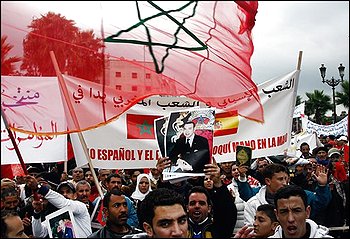
MOROCCO MARCHES AGAINST SPANISH CENTRE-RIGHT
Hundreds of thousands of Moroccans marched on Sunday in Casablanca to protest against criticism by Spain’s Partido Popular of alleged human rights abuses in the disputed Western Sahara. Waving Moroccan flags and banners, the protesters led by Prime Minister Abbas el Fassi chanted: “Popular Party, enemy of Morocco.”
I say hundreds of thousands, one report I read said three million. If there is a demonstration in Spain the organisers may say 5,000 took part, the National Police 3,000 and the local police 1,500.The truth lies between the highest and lowest figure. There certainly was a major demonstration in Casablanca – as to how many were there – well your guess is as good as mine.
I have reflected on this for a couple of days because the protest wasn’t against Spain or the Spanish government but the Partido Popular. The curious thing here is that the PP is not the Spanish party of government but is the opposition. I can’t think off hand of any other mass protest against a non-ruling party. However opinion polls point to the centre-right party triumphing in the March 2012 general election – not only in Madrid but perhaps also in the regional government in Andalucía, the nearest part of Spain to Morocco.
In statements over recent months the PP has made it clear that if it wins the 2012 general election in will be much tougher with its neighbour across the Strait of Gibraltar. It has accused the PSOE government of weakness towards Rabat, is angry over the EU accord with Morocco that will hit Andalucía agriculture and fisheries and has been outspoken in its support of the security forces in Ceuta and Melilla – the two enclaves that Morocco views as occupied territories.
Indeed in August the former Spanish PP premier, José María Aznar, broke off from his holiday in Marbella to visit the Melilla border where tensions were running high between the enclave and Moroccans. Morocco had accused the National Police and Guardia Civil of acting in a racist manner towards its citizens and a food import blockade had been imposed. Needless to say the visit of the strutting Aznar did nothing to calm these troubled waters. That was left to the Spanish monarch who has close ties with his Moroccan counterpart.
Now we have to add to that mix the Western Sahara which is normally the sole preserve of the left. The PP took part in a rally in Madrid last month alongside socialist, far-left and trade union groups to denounce Morocco for allegedly abusing human rights in Western Sahara. PP activists were also present in Valencia last week to show their support for Saharan refugees who had first locked themselves in the PSOE HQ as they are furious over the socialist government’s inaction on the issue. When evicted they staged an on-going protest in the street outside.
So on reflection it is no surprise that Fassi’s Istiqlal party and 15 other political groups issued a joint statement attacking the PP for its “unbridled activism against Morocco.” They argued the party had swayed last week’s vote of European lawmakers in favour of a United Nations-backed probe into violence in the former Spanish colony.
Moroccan security forces and pro-independence protesters clashed on November 8 in the disputed territory, which was annexed by Morocco in 1975 after Spain withdrew from its former colony. Several members of the security forces and civilians are reported to have died. The violence, amongst the worst in years, prompted the Polisario Front which wants independence for the territory to call for an independent UN investigation.
With the centre-right is in the ascendancy in Spain you can expect tensions with Morocco and the British colony of Gibraltar to increase if the Partido Popular comes to power. It is also a depressing prospect for socialists, the far-left and the unions in Spain because whilst the country has suffered in the economic crisis under the socialist government the medicine to come will be far bitterer under Mariano Rajoy’s PP than it ever was under José Luis Rodríguez Zapatero's PSOE.
Monday, November 29, 2010
IS THE FRENTE POLISARIO A TARGET FOR AL QAEDA?
I am grateful to my esteemed colleague Francisco Rubiales for pointing me to reports that the Frente Polisario in the Western Sahara may have been targeted by Al Qaeda.
Francisco, apart from being a much respected journalist, was the EFE correspondent in Cuba, Central America and Italy as well as being an advisor to the UN. Currently he also writes the very interesting Voto en Blanco blog.
Francisco reports that because of the frustration the Frente Polisario is suffering in its campaign for independence for the Western Sahara from Morocco and the lack of support from major nations it could be driven in to the hands of Al Qaeda.
Apparently some experts and think tanks dedicated to world politics in the USA and France have been discussing this possibility which if it happened would be a drastic and dangerous change in the Maghreb. It would also increase the instability in that part of the world that is of great strategic value.
Currently Al Qaeda is not a major force in the Maghreb. Its activities are confined to areas of Mali and Mauritania where it has staged a number of kidnappings – perhaps because it is short of funds. Naturally if it were to team up with an armed force such at the Frente Polisario that limited influence would be greatly increased.
Francisco says that many sectors of the Polisario and the people of the Western Sahara are now calling for a restarting of the armed struggle against Morocco. If it was a conventional war then Morocco would easily outnumber its opponents however if it because a conflict for which Al Qaeda is famed – guerrilla attacks, kidnappings and major strikes to attract the attention of the rich countries then the results could be terrible for Morocco.
Movements amongst Saharan veterans and reservists have already been detected. They have experience of past conflicts which would be invaluable in a renewed armed conflict with Morocco. Experts place the strength of the Polisario at around 70,000 – insignificant in a conventional war but scary if used in insurgency and guerrilla warfare.
The Polisario representative in Spain, Bucharaya Beyun, has declared before the media they have weapons and combatants sufficient for a war and many sections of the population in the Western Sahara are putting pressure on the organization to return to fighting Morocco.
Up till now the people of the Western Sahara have placed their hopes with the UN and the good offices of Spain and the USA to resolve the conflict. However if Morocco continues with its campaign of repression against El Aaiún and refuses to agree to a negotiated solution which allows for the self-determination of the Western Saharan people then the outcome could be terrible indeed.
Interestingly Abdeslam Maghraoui, a political science professor at Duke University who specializing in terrorism in North Africa, says there isn’t any indication that Morocco is a strategic priority for the Al Qaeda. According to the professor it has two minor networks in the country: the Moroccan Islamic Combatant Group responsible for the 2003 Casablanca attacks and the 2004 metro bombings in Madrid; and the Salafiya al Jihadiya, which operates in medium-sized Moroccan towns.
However it appears Abdeslam Maghraoui agrees with the assessment of Francisco because he has stated that Al Qaeda in the Islamic Maghreb might find non-ideological support among disenchanted Sahrawi militants in Tindouf who don’t see an end to the dispute over the Saharan region.
Thursday, November 25, 2010
DOMESTIC VIOLENCE IS A MALE PROBLEM
Today, November 25, is the international day against domestic violence.
My view on this is very simple: I have zero tolerance for anybody, male or female, who inflicts violence on their partner or ex-partner. I believe men have a special responsibility to take a stand against this blight to our society. In the majority of cases, not all but the majority, it is men who inflict the violence. Hence it is the men in society who have to put a stop to it.
I live in Andalucía and according to the regional government there are 73 reports of domestic violence every day. The data formed a report for region’s parliament which shows there were 26,838 such complaints last year. This figure amounts to a 7.8 increase over 2008.
In 2009 the courts in Andalucía issued 5,287 protection orders. The Andalucía minister of equality and social welfare, Micaela Navarro, says it is vital that women in this situation report their cases so that help and assistance can be given.
The ministry has also published the provisional figures that show 15 women have died in Andalucía so far this year from domestic violence – more than the total in 2009. At the time of writing there have been 63 deaths in wider Spain.
Since the laws to offer the sufferers of domestic violence protection the nation has been stunned by the number of cases and the violent deaths. Ironically whilst such violence has always existed it has been behind closed doors. Now the suffers come forward and all too often their partners react by killing them. The laws have simple not kept up with developments. In many cases the problems have been caused by the laws that are meant to offer protection. Nor are these crimes restricted to the young or middle aged – what has surprised me more than anything is the cases involving men and women in their 70s or 80s.
It is true that many of the deaths from domestic violence involve immigrants to the country. In many areas the number of cases of abuse involving non-Spaniards exceeds those of nationals. In Algeciras there is a major problem with Moroccans who form a large immigrant group – on the Costa del Sol I am ashamed to say that Britons and Northern Europeans feature highly in the number of court cases.
It is not a Spanish problem it is an international problem hence the holding of this special day. Yet in essence it is a male problem and so we men have to solve it.
Wednesday, November 24, 2010
VALENCIA BECOMES FOCUS OF WESTERN SAHARA PROTESTS
It was two weeks ago on Tuesday that the Frente Polisario press agency, SPS, alerted the world to what was taking place at the Gdeim Izizk protest camp close to the Western Saharan capital of El Aauín. We are not sure precisely what happened, how many were killed, injured or disappeared because it would be wrong to merely rely on the word of the SPS and Morocco has banned all Spanish journalists, politicians, Euro MPs and international observers from going to see.
This Tuesday in the early hours of the morning I received a message Guillermo O William. He said that as he wrote four Policía Nacional vans had arrived at the PSOE office in Valencia at 24.10. They had sealed the windows and cries could be heard from the 16 protestors inside. He added the police wanted to silence the activists who had been holding a peaceful sit-in protest in the PSPV office (PSPV is PSOE in Valencia).
Moving in at the dead of night is a usual Policía Nacional tactic. Many years ago I saw squads of baton waving officers clearing hundreds of Moroccan cars blocking the road to Algeciras port. The cars packed with families of Moroccans travelling home for the summer holidays from their jobs in Northern Europe had been kept out in the boiling sun all day as they waited for a ferry home. Many had collapsed in the heat, some died, so they protested by blocking the road. After the events of that year a new system of moving the million of Moroccans through was introduced that treats them in a civilized manner.
Since the current crisis erupted in the Western Sahara refugees from the region have been holding a series of weekly protests outside the Moroccan Consulate in Valencia. The Tuesday demo was the fifth and then the protestors marched to the PSPV-PSOE office to team up with the Western Saharans who had previously occupied the building and were not encamped outside.
The PSOE office protest was against the “silence” of the socialist government in Madrid both over what was happening in the Western Sahara and Morocco’s embargo on media, political and observer visits. The spokesperson for the activists, Nadira Mohamed, said there were now 150 protesting at the doors to the socialist’s office with a heavy police presence.
Mohamed explained the weekly protest at the consulate has the objective of “denouncing the constant violation of the human rights that Morocco is carrying out in the Western Sahara.” Now to this has been added anger at the “passivity” of the Spanish Government before the “violence” of the Moroccan army on the Saharan people that came to a head “with the assault on the Gdeim Izizk camp on November 8.”
Whilst the SPS has warned of civil war in the Western Sahara it is PSOE in Spain which is being torn apart over the issue. Activists are at angry odds with their government. There is widespread dissatisfaction with Madrid’s response to the dismantling of the ‘Campamento Dignidad’. Whilst many party members are openly challenging José Luis Rodríguez Zapatero and his new foreign minister, Trinidad Jímenez, the party baron’s are also unhappy but have confined their anger to mumbling under their breath.
More open with its protests is Izquierda Socilista that is demanding the government responds with “determined action” making a “firm and explicit condemnation” of the actions of Morocco since 1975 when the dying Franco regime withdrew hastily from its former colony. Zapatero has tried to defend the actions of his government but the ante is being upped by the centre-right Partido Popular.
The PP is no friend of Morocco and has stated that should it come to government in 2012 it will deal with its neighbour across the Strait of Gibraltar in a firm manner. This would include agriculture and fishing policy but especially in its defence of the enclaves of Ceuta and Melilla – which Morocco views as occupied territories.
The Western Sahara and support for the Frente Polisario has been a touch stone for socialists and those on the far left in Spain and wider Europe. Hence it is ironic that the PP is now able to use this issue to drive another nail in to PSOE’s electoral coffin and at the same time to put pressure on Morocco’s monarch and government.
Monday, November 22, 2010
LAUGH? THEY COULD DIE!
The Polisario Front has spoken of its dismay at the lack of support from the Spanish premier, José Luis Rodríguez Zapatero, which it described as “minimal”. It also accused him of having “little interest” in the situation in the Western Sahara capital of El Aaiún, after the violent dismantling of the protest camp at Gdeim Izik on November 8.
In statements to Saharan journalists the prime minister of the self proclaimed RASD government, Abdelkader Taleb Omat, considers that Zapatero had ignored in his declaration at the NATO summit in Lisbon the serious situation existing at El Aaiún under Morocco’s control.
Taleb Omat spoke of his surprise that the Spanish government had not demanded an urgent independent international investigation as to why Morocco will not lift its blockade on the free access to the region of Spanish journalists and international observers to the Western Sahara. He added this would save lives and would protect the Saharans from the Moroccan policy to exterminate them.
The RASD premier also deplored the fact that Zapatero did not raise fundamental questions on a referendum for self-determination and the respect for human rights.
Now you’d probably rightly say what’s to laugh about in that? The answer is of course nothing especially as we have no idea just how many have died, been seriously injured or have disappeared. If the situation wasn’t so serious the humour would be in the political fall-out in Spain.
The Western Sahara was a Spanish colony and was literally dumped in to the hands of Morocco and Mauritania in the dying days of the Franco regime. Now the centre right opposition Partido Popular is turning up the heat on Zapatero and intends to raise the subject in the Spanish Upper House, the Senate. The PP says it will condemn “the serious violation of human rights” on the part of Morocco in the Western Sahara. It also wants Spain to return to its former position of openly supporting the decolonisation process.
PP Senator Alejandro Muñoz Alonso has presented a motion that calls on the government “to condemn the serious violations of human rights that have been produced” and also the controls that have impeded press freedom and the activities of professionals in the media. The PP also wants the mandate of Minurso, the UN force in the region, to be changed to give it competence over human rights to allow it to stop the violence.
Of course support for the Polisario Front in Spain and elsewhere has always been the fiefdom of the centre left and far left. Izquierda Unida has been outspoken over the disaster that is taking place in the Western Sahara but the PSOE government seems intent on pretending it simply isn’t happening. This has caused outrage amongst many PSOE activists who are pressing their government to change it stance. They are engaged in a series of demos, sit ins and protests – not against Morocco but their own government in Madrid.
As the old saying goes – laugh – I could cry but in the meantime the people of the Western Sahara are dying!
Subscribe to:
Posts (Atom)